
Practice Flow research
The AI Adoption Gap
What 84 primary care workflows show about why AI in a practice stalls.
By Kamran Qamar, Founder, Practice Flow
Your practice already has AI in it. Inside the EHR, and probably alongside it. The return the vendor described has not arrived, and the explanations on offer all point at something else to buy.
So we stopped looking at AI products and looked at the work instead.
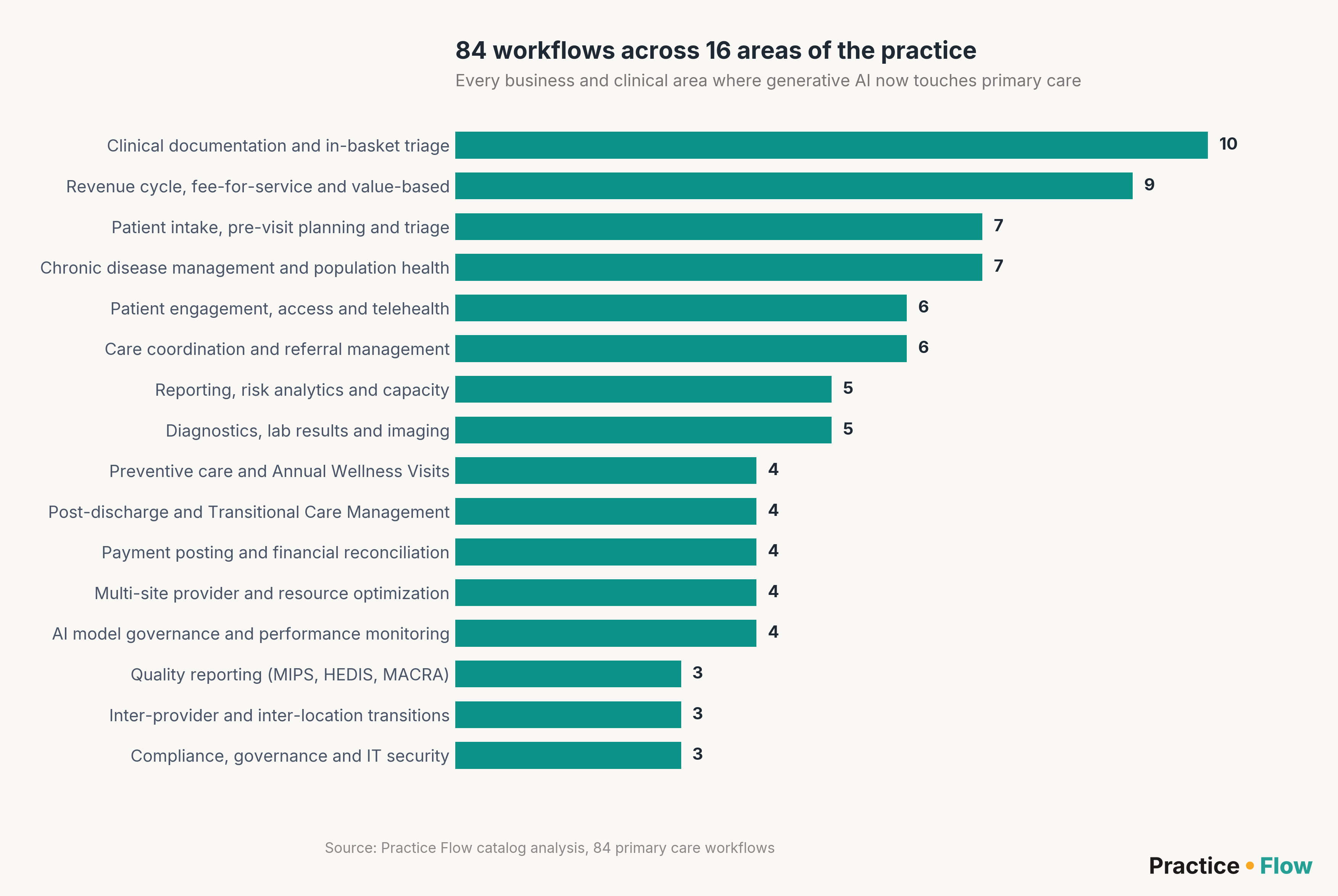
- 84 workflows documented across 16 areas of a primary care practice, from the first call a patient makes to the last claim that closes.
- One question asked of each. Why is this not delivering the productivity the vendor promised?
- Two blockers carry 86% of the value. Neither one is a technology problem. The report names both and says what clears them.
- Eight of the 84 need an engineering build. That is the list most practices get wrong in both directions.
It is written for practice owners and administrators. Not for vendors, and not for a procurement committee. Nothing in the finding depends on you buying anything.
One workflow, worked
Take ambient scribing. The practice bought it, the providers were trained, and the time never came back. The blocker is not training. Providers do not yet trust the draft, so they re-read every line and net-save almost nothing.
More training does not clear a trust blocker. That distinction runs through the whole catalog, and it decides what a practice should do first.
Get the report
Twenty-four pages. The full method, the finding, and what to do first.
How it was done
We wrote down what would prove us wrong, before we started.
Before a single workflow was classified, we recorded the result that would have killed the hypothesis. If integration had led the blockers, or if the value had sat in the workflows that need an engineering project, the answer would have been that the money is behind the software. We would have published that.
The definitions each workflow was classified against are in the report rather than held privately, so you can run the same classification on your own practice and disagree with ours. The limitations are stated too, including the one we most want answered next.
What you get
What is in the report.
- The five blockers, with the definitions used, so you can run the same classification on your own workflows
- The delivery split: which workflows are reachable with training and light configuration, and which genuinely need engineering
- The three tests that decide what to do first, and the short list of workflows that survive all three
- A sensitivity analysis that re-runs the finding on two harder bases, including hard cash only
- The three ways an AI business case quietly inflates itself, with our own catalog as the example
- What the AI already running in your practice means for a HIPAA-covered entity
- A stated limitations section, including the question this study cannot answer yet
- An appendix walking all 84 workflows by stage of the patient journey, so you can find your own week in it
Who wrote it
Practice Flow is a firm of healthcare operators.





The CEO of a 25-provider multispecialty clinic. A program manager on the modernization of the VA's national EHR at Oracle-Cerner. A practice manager over patient access and prior authorizations in oncology and cardiology. A physician who built and ran his own clinic for seven years.
The catalog analysis came first and the firm followed from it. We did not start a consultancy and then go looking for a finding that recommended what it sells.
What we do now is the AI transformation work for private healthcare practices. We redesign the workflows AI now touches, automate what it can carry, rewrite the procedures behind them, and train the people who run them.
The people behind Practice Flow → · Or talk to us for twenty minutes →